A switchboard upgrade is one of those jobs most Brisbane property owners only think about once something goes wrong — a breaker that keeps tripping, an air conditioner that can’t be installed, or an electrician who takes one look at the meter box and shakes their head. Because it sits behind a panel most people never open, it is also one of the hardest jobs to budget for.
This guide explains what actually drives the cost of a switchboard upgrade in Brisbane in 2026, what you get for the money, and how to tell whether yours needs replacing or simply servicing.
What a switchboard upgrade actually involves
A switchboard upgrade replaces the old fuse or circuit-breaker panel that distributes power through your property with a modern board built to current Australian Standards. In practice that usually means:
- Replacing ceramic rewireable fuses with modern circuit breakers
- Installing safety switches (RCDs) on all final sub-circuits
- Fitting a main switch rated correctly for the property’s load
- Re-terminating and labelling every circuit so faults can be isolated quickly
- Bringing earthing and bonding up to standard
- Leaving enough spare capacity for future circuits
The last point matters more than most people expect. A board that is technically compliant but completely full will need to be opened up again the first time you add a pool pump, an EV charger or ducted air conditioning.
What drives the price
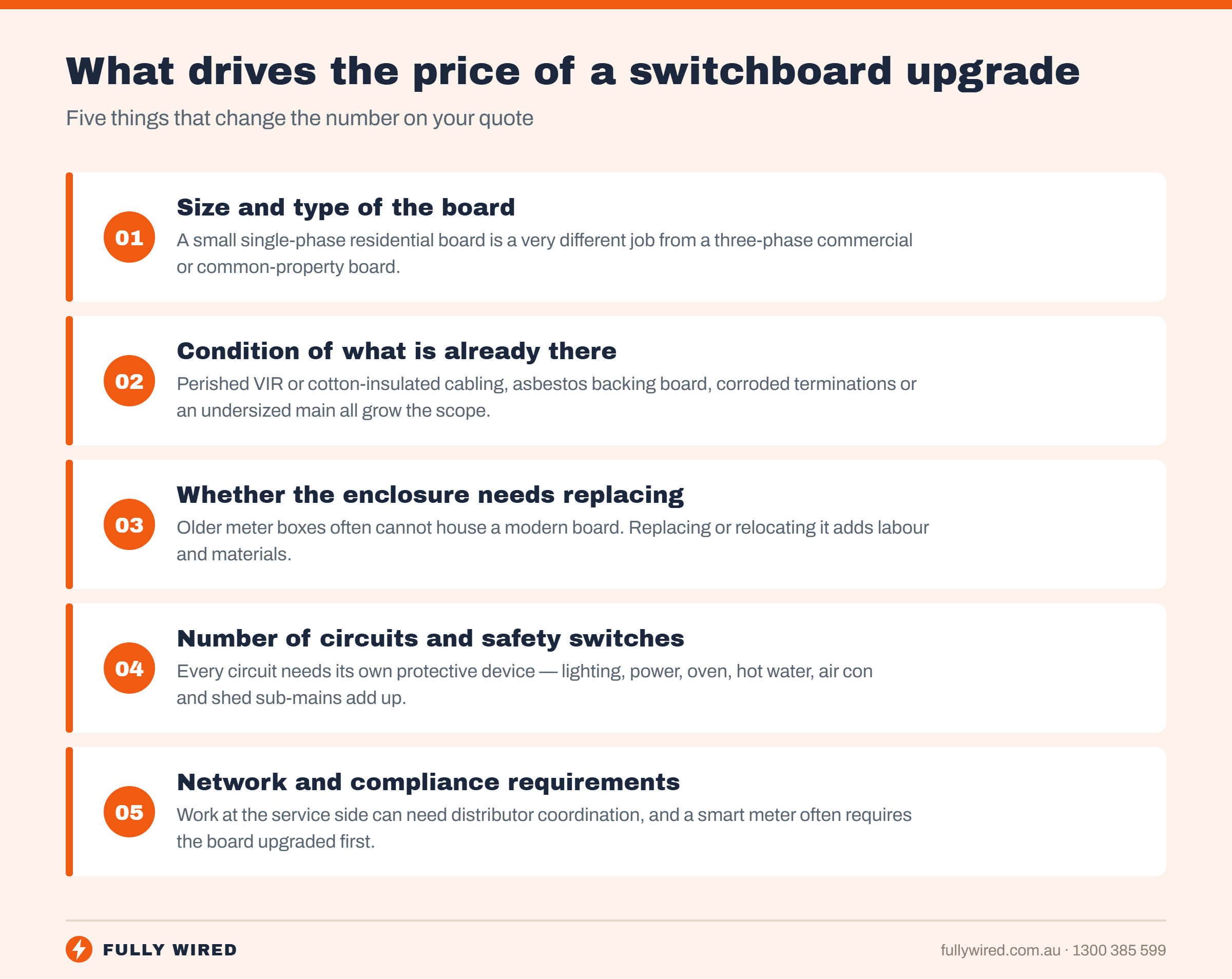
1. The size and type of the board
A small residential board serving a two-bedroom unit is a very different job from a three-phase board in a warehouse or a common-property board in a unit complex. Single-phase residential upgrades sit at the lower end of the range; three-phase and commercial boards sit well above it.
2. The condition of what is already there
If the existing wiring into the board is sound, the job is largely a swap. If the electrician finds perished VIR or cotton-insulated cabling, asbestos backing board, corroded terminations or an undersized main, the scope grows. This is the single biggest reason two quotes for the same job can differ substantially.
3. Whether the meter panel or enclosure needs replacing
Older meter boxes often cannot physically house a modern board. Replacing the enclosure, and sometimes relocating it to meet current clearance rules, adds both labour and materials.
4. Number of circuits and safety switches
Every circuit needs its own protective device. A property with lighting, power, oven, hot water, air conditioning and a shed sub-main needs considerably more hardware than a small unit.
5. Network and compliance requirements
Work at the service side of the board can require coordination with the distributor, and in some cases a temporary disconnection. Where a smart meter is being installed, the board often has to be brought up to standard first — something we cover on our smart meter switchboard check page.
What changes the number most
Every property is different, so treat the following as a planning guide rather than a quote:
- Straightforward single-phase residential upgrade — the most common job, where the existing enclosure and mains are sound.
- Single-phase upgrade with a new meter enclosure — add the cost of the enclosure, mounting and make-good.
- Three-phase residential or light commercial upgrade — typically the largest step up in price, driven by hardware and additional labour.
- Body corporate common-property boards — priced per board, and usually staged across a complex so residents are not without power at the same time.
Rather than publishing a headline figure that will not match your property, Fully Wired quotes switchboard work on site with an upfront fixed price before any work starts. You see the number, and the scope behind the number, before you commit.
Signs your switchboard needs attention now
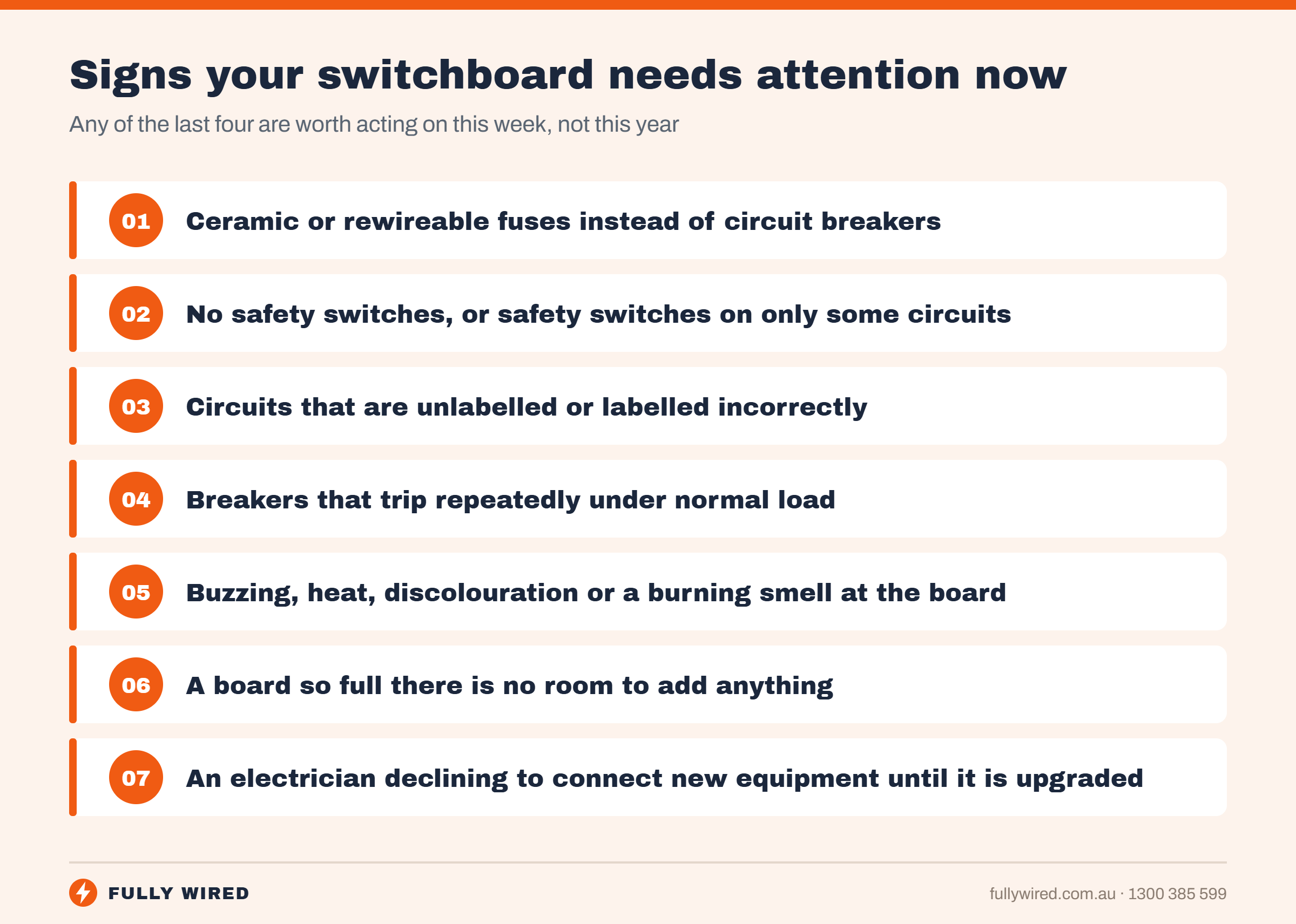
- Ceramic or rewireable fuses instead of circuit breakers
- No safety switches, or safety switches on only some circuits
- Breakers that trip repeatedly, especially under normal load
- Buzzing, heat, discolouration or a burning smell at the board
- Circuits that are unlabelled or labelled incorrectly
- A board so full there is no room to add anything
- An electrician declining to connect new equipment until the board is upgraded
Any of the last four are worth acting on quickly. Heat and discolouration in particular indicate a loose or failing connection, which is a fire risk rather than an inconvenience.
Upgrade or repair?
Not every problem board needs replacing. A single failed breaker, a loose termination or a missing label can be fixed in a service visit. The upgrade conversation starts when the board lacks safety switches, has no spare capacity, or is old enough that replacement parts are no longer available.
A thermal imaging inspection is a useful middle step for commercial and body corporate boards. It identifies hot joints and overloaded circuits before they fail, which often allows an upgrade to be planned and budgeted rather than done as an emergency.
What to ask for in a quote
- An itemised scope, not a single lump sum
- Confirmation that safety switches will cover all final sub-circuits
- The number of spare ways left in the board
- Whether the enclosure is being reused or replaced
- Expected outage time on the day
- A Certificate of Testing and Compliance on completion
Getting a number for your property
Fully Wired has been upgrading switchboards across Brisbane, Ipswich, the Sunshine Coast and the Gold Coast since 2008, for homes, businesses and body corporate complexes. We provide same-day onsite quotes with upfront pricing, so you know the cost before the work begins.
Learn more about our switchboard upgrades or book a quote to get a firm price for your board.