Electrical compliance is one of those responsibilities that sits quietly in the background of a body corporate until something goes wrong — a failed audit, an insurance query after an incident, or a committee member asking when the emergency lights were last tested and nobody being able to answer. The obligations themselves are not complicated. What catches committees out is that they sit across several different pieces of legislation, run on different schedules, and are split between the body corporate and individual lot owners. This checklist sets out what a Queensland committee should have on its radar, who is responsible for each item, and how often the work needs to happen.
Where the responsibility sits
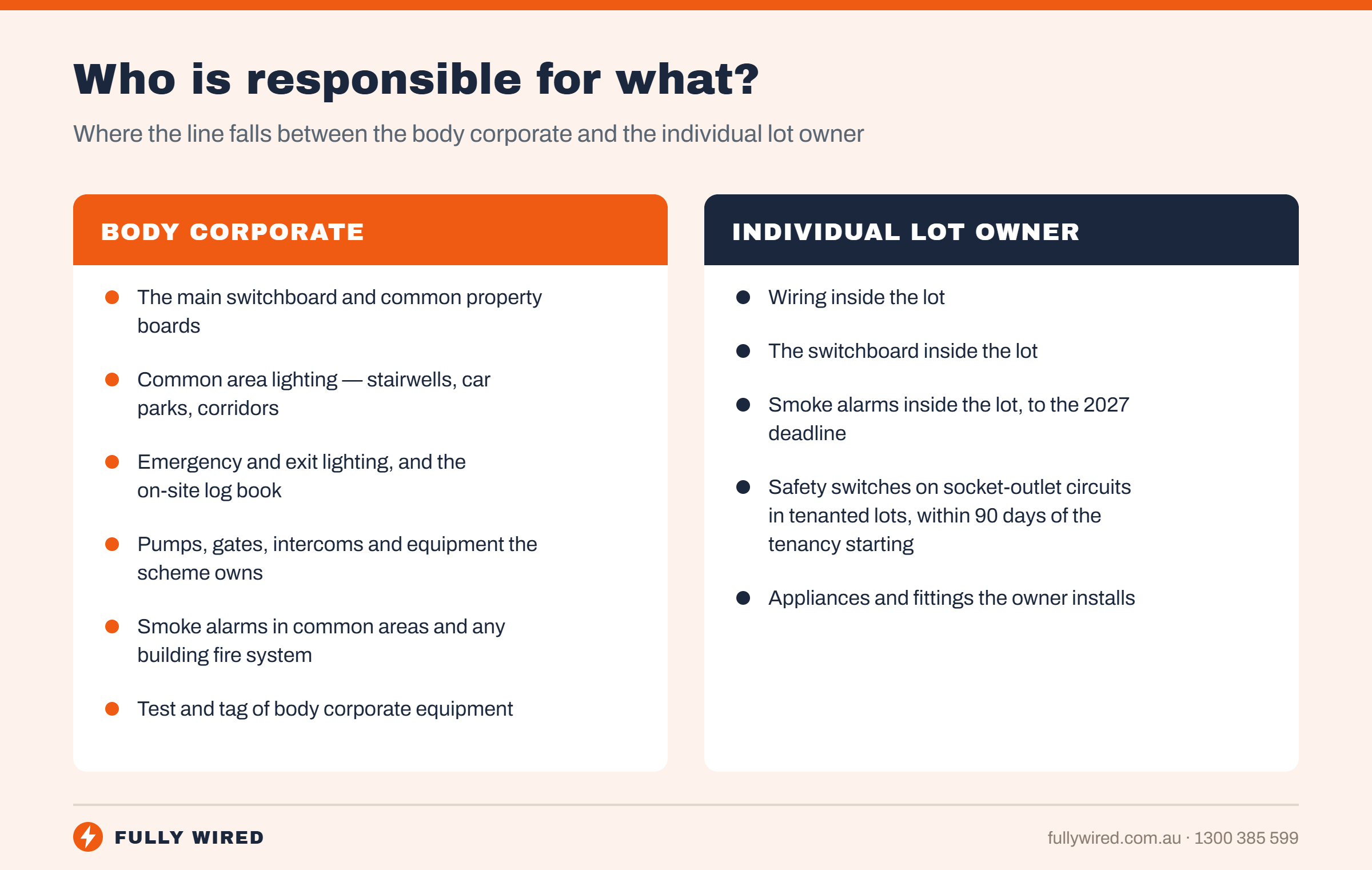
Under the Body Corporate and Community Management Act 1997, the body corporate must maintain common property in good condition. Under Queensland electrical safety law, whoever has management or control of electrical equipment has a duty to make sure it is electrically safe. In practice that means the body corporate is responsible for electrical work on common property — the main switchboard, common area lighting, car park and stairwell circuits, emergency and exit lighting, pumps, gates, intercoms and any equipment the body corporate owns. Individual lot owners remain responsible for the wiring, switchboard and smoke alarms inside their own lot. Committees run into problems when that boundary is assumed rather than checked. If your scheme has not had the split documented, it is worth confirming it against the community management statement before you build a maintenance program around it.
The committee checklist
1. Smoke alarms
Queensland requires interconnected photoelectric smoke alarms complying with AS 3786:2014. Homes that are sold, leased or have a lease renewed have needed compliant alarms since 1 January 2022, and all remaining private dwellings — including townhouses and units — must be compliant by 1 January 2027. Alarms inside a lot are generally the owner’s responsibility, but many schemes coordinate a whole-of-complex rollout so every lot is upgraded consistently and at a better price. Alarms in common areas and any building fire system remain with the body corporate. See our smoke alarm installation and servicing page for what a complex-wide rollout involves.
2. Safety switches on common property
Safety switches (RCDs) cut power in a fraction of a second when current leaks to earth, and they are the single most effective protection for anyone working on or using common property equipment. Where common property circuits do not have RCD protection, adding it should be treated as a priority rather than an upgrade to consider later. For lots that are tenanted, Queensland law requires safety switches on general purpose socket-outlet circuits, installed within 90 days of the start of the tenancy agreement. Committees with a high proportion of rented lots often find it useful to remind owners of that obligation. Our safety switch installation and testing page covers testing intervals in more detail.
3. Emergency and exit lighting
If your building has emergency or exit lighting, it needs to be tested and maintained in line with AS 2293.2. That means a six-monthly discharge test, with results recorded in a log book that is kept on site and available if it is ever asked for. This is the item most often missed, because emergency lights look fine until the day they are needed. Book it as a recurring appointment rather than something the committee has to remember. We cover the process on our emergency lighting testing page.
4. Test and tag for body corporate equipment
Any electrical equipment the body corporate owns or supplies — cleaners’ equipment, pool and plant room gear, tools kept on site, appliances in a common room — falls within workplace testing and tagging practice under AS/NZS 3760. Intervals depend on the environment the equipment is used in. It is a small job that produces a clear record, which is exactly what you want if there is ever an incident. See electrical test and tag for how intervals are set.
5. The main switchboard
Older main switchboards in unit complexes are frequently at capacity, still carrying rewireable fuses, or missing the space needed for RCDs and metering changes. A switchboard that cannot take another circuit becomes a bottleneck the first time the scheme wants to add EV charging, upgrade lighting or install air conditioning in a common area. An inspection tells you whether you are looking at a repair, a staged upgrade, or a full replacement to budget for in the sinking fund. Our switchboard upgrades page explains what an upgrade involves for a body corporate property.
6. Preventative inspections
Loose connections and overloaded circuits give off heat long before they fail. Thermal imaging of the main switchboard and distribution boards finds those hot spots while they are still cheap to fix, and gives the committee a dated report to file.
7. Common area lighting
Stairwells, car parks, corridors and garden lighting are the parts of the property residents notice fastest. A scheduled lighting maintenance visit replaces failed fittings in one trip rather than through a series of individual callouts, and is usually the cheaper way to run it.
Building a twelve-month compliance calendar
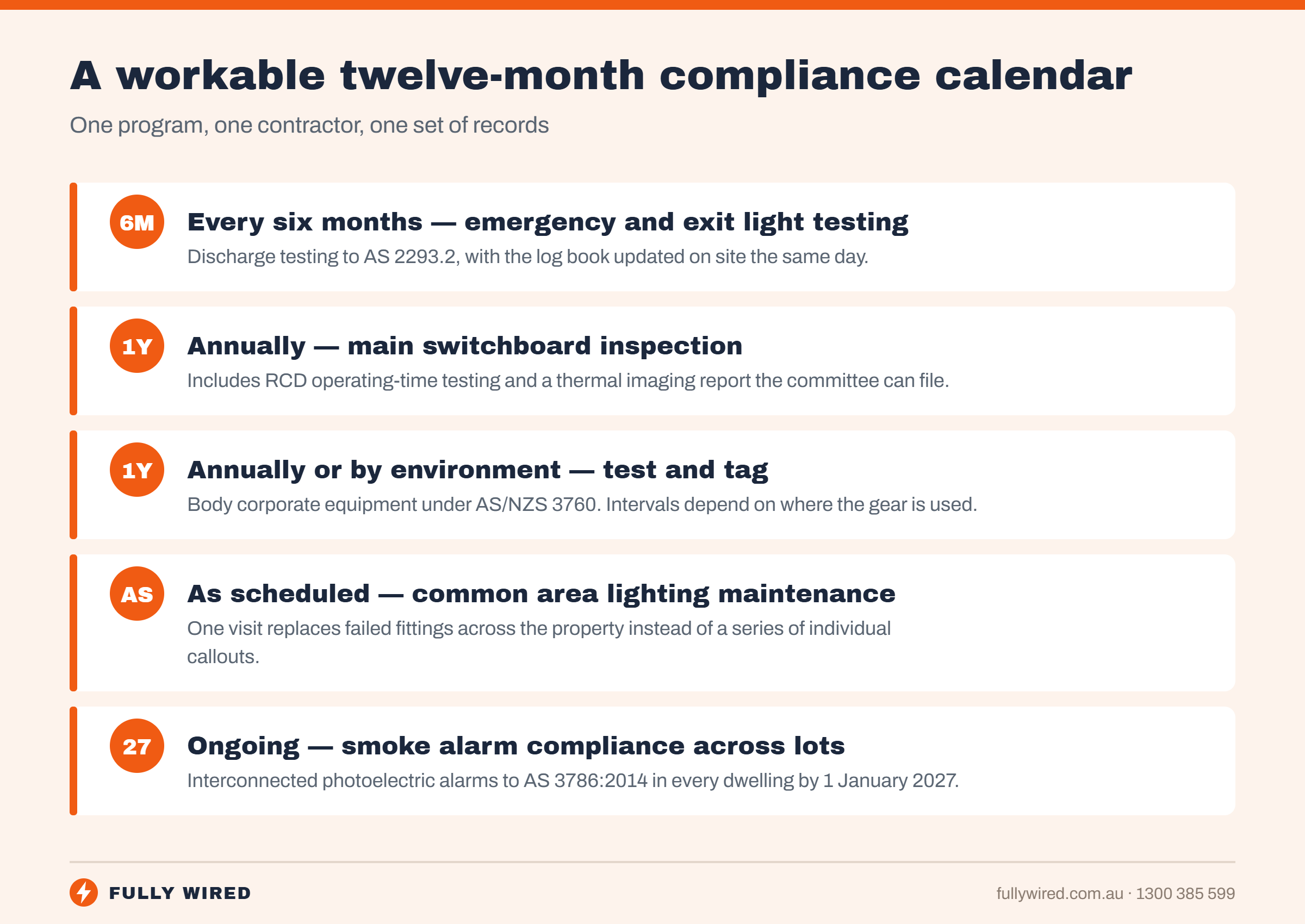
Most schemes are better served by a calendar than by a list. A workable starting point looks like this:
- Every six months — emergency and exit light testing, with the log book updated on site
- Annually — main switchboard inspection, RCD operating-time testing, thermal imaging report
- Annually or by environment — test and tag of body corporate equipment
- As scheduled — common area lighting maintenance visits
- Ongoing — smoke alarm compliance across lots, tracked to the 2027 deadline
Putting these on one program means one contractor, one set of records and one point of contact when a certificate is requested at short notice.
What to ask your electrical contractor
- Are you licensed for the work, and can you supply certificates of testing and compliance?
- Will you provide a written report the committee can file and hand to a new manager?
- Can testing be scheduled as a recurring program rather than booked each time?
- How are after-hours and urgent callouts priced?
- Do you work with the body corporate manager directly on approvals and reporting?
Getting a program in place
Fully Wired has worked with body corporate committees and strata managers across Brisbane and South East Queensland since 2008, and runs scheduled compliance programs for complexes of every size. If your scheme does not have one, the first step is usually a walk-through and a written summary of what is due and when. Read more about our body corporate electrical services and electrical safety compliance program, or get in touch to arrange an inspection. This article is general information for Queensland body corporate committees and is not legal advice. Confirm your scheme’s specific obligations with your body corporate manager.